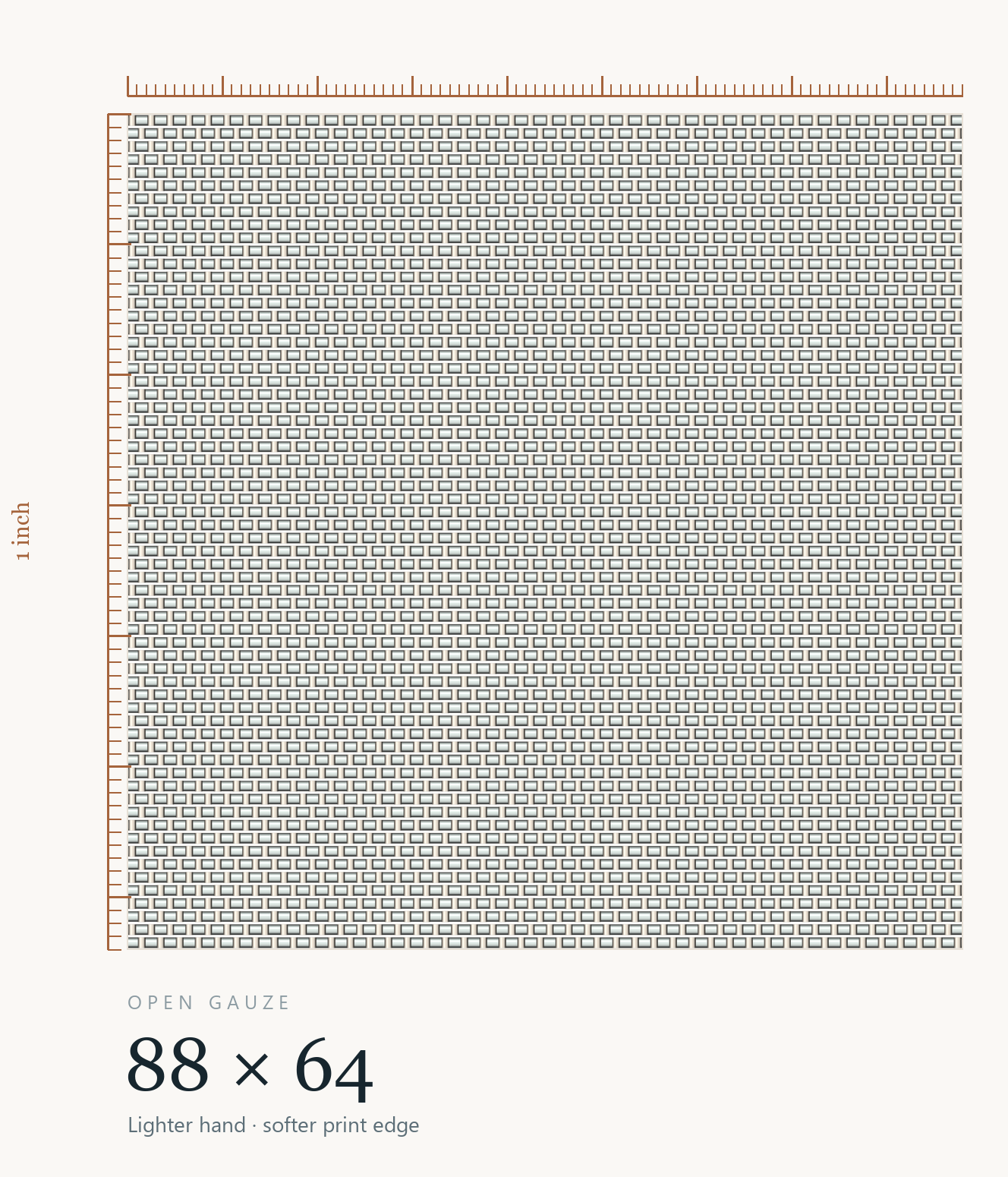
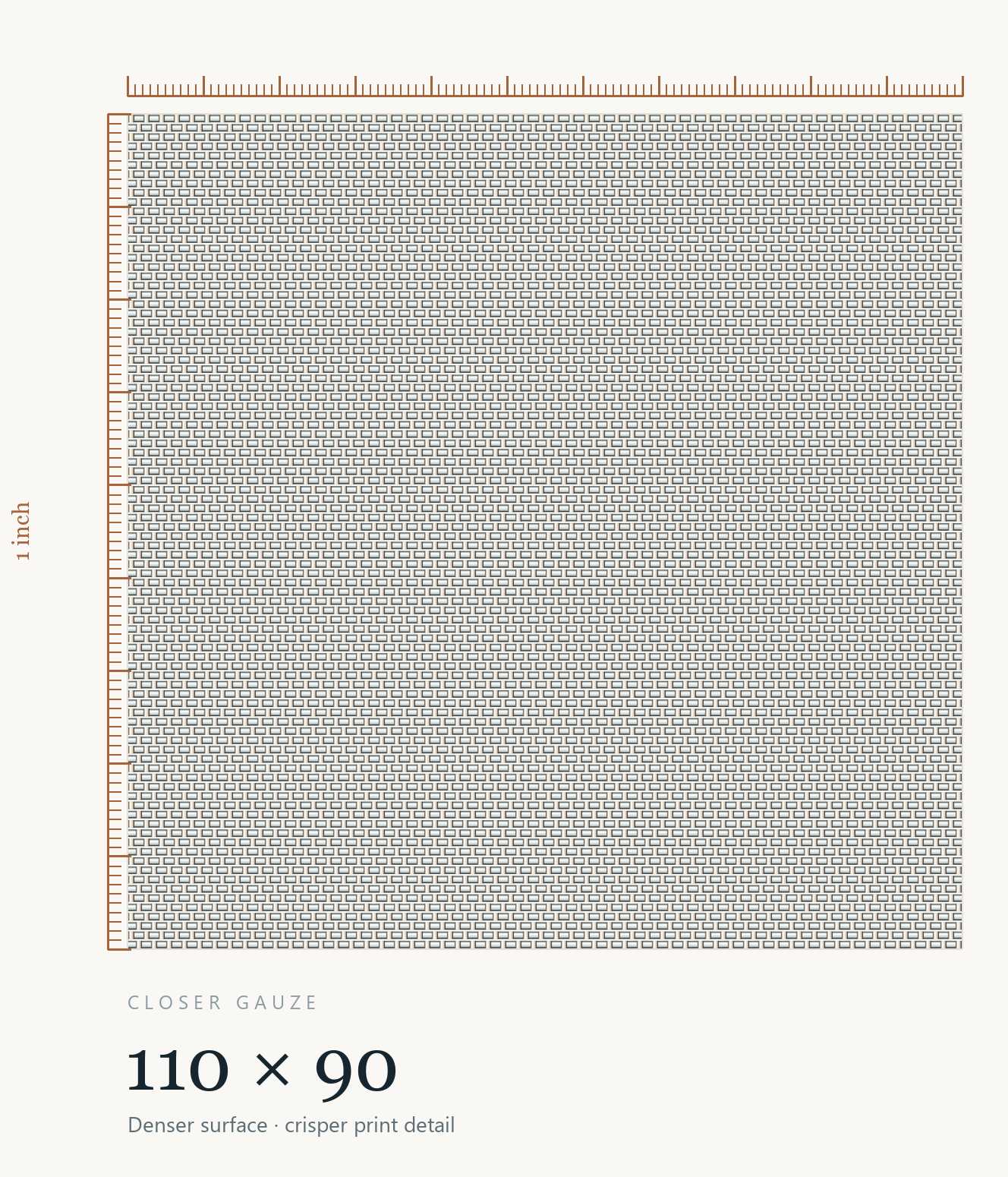
Ask two suppliers for "cotton muslin" and you will receive two different fabrics. Ask them for the weave density and the difference starts to explain itself. Density is written as two numbers — warp × weft, the threads per inch running lengthwise and crosswise. 110 × 90 means 110 warp threads and 90 weft threads in every square inch. 88 × 64 means fewer of both.
The illustrations below show a one-inch square of each construction, drawn to the same physical scale, with the thread positions marked on the rulers.
What the density changes
Density is not a quality grade — it is a construction choice. Each direction has a consequence:
| Property | 88 × 64 (open) | 110 × 90 (closer) |
|---|---|---|
| Hand feel | Airier, softer drape, folds smaller | More substantial, smoother surface |
| Printing | Ink bleeds slightly — fine lines and small type lose definition | Holds fine lines and small logo type cleanly |
| Opacity | More light passes through | More coverage per layer |
| GSM (per layer) | Lower — less cotton in the same area | Higher — more cotton in the same area |
| Cost | Less yarn, faster loom speed | More yarn, slower loom |
| Best suited to | Swaddles, airy summer blankets | Crib sheets, printed blankets, anything with detailed artwork |
The printing line is the one buyers notice first. A delicate watercolour pattern survives on both constructions; a fine geometric or small repeating logo needs the closer weave, or it arrives softened into fuzz.
The question that matters more than the number
Here is the part most specification sheets miss: a density figure is only meaningful at a stated point in the process.
Woven fabric is measured off the loom as greige. Then it is bleached, dyed or printed, washed, and finished — and each step moves the threads. Relaxation in washing can drop the measured density by a few percent; calendering can push it up. The same physical fabric can read 88 × 64 on the greige state and 90 × 66 after finishing.
So when a supplier quotes a density, the useful follow-up is not "can you do 110 × 90" but "110 × 90 measured where — greige or finished?" Comparing one supplier's greige figure against another's finished figure is how buyers end up with two samples that feel nothing alike despite matching paperwork.
How to verify it yourself
You do not need a laboratory. A pick glass — a small folding magnifier with a marked graticule, the tool every fabric inspector carries — lets you count threads directly on the fabric surface.
- Lay the fabric flat without stretching it. Tension distorts the count.
- Count warp and weft threads across the marked inch (or centimetre, then convert).
- Repeat in at least five spots across the width — density varies across a roll, and a single reading can flatter or slander the fabric. This is standard practice under ISO 7211-2.
- Note the fabric state when you measured: greige, washed, or finished.
Written by the Pomiso Cotton team. We make muslin swaddle blankets, crib sheets and burp cloths for OEM and private-label brands, in partnership with our production base in Shandong.